
The color you pick affects more than aesthetics. It changes how bright or enclosed a room feels, how much visual flow exists between spaces, how doors read against your trim and flooring, and even how much upkeep you're signing up for. Many homeowners struggle with this decision because they're choosing from a paint chip or a screen, not the actual room.
This guide breaks down how black and white interior doors perform across lighting, room function, existing finishes, traffic levels, and material, so you can make a decision that holds up once the door is actually hanging in the frame.
Key Takeaways
- White doors suit bright, flexible, timeless spaces and help smaller or darker rooms feel more open.
- Black doors create contrast and a bolder, more architectural look, especially in well-lit rooms.
- Durability depends on finish quality and material, not door color.
- Pick one color for whole-home continuity, or mix both using a clear room-by-room rule.
- Always test a physical sample against your actual lighting, flooring, and trim before ordering.
Black vs White Interior Doors: Quick Comparison
| Factor | Black Doors | White Doors |
|---|---|---|
| Visual effect | Strong contrast, defined focal point | Quiet, blends into walls and trim |
| Room size & brightness | Needs ample light; can feel heavy in tight spaces | Reflects light, opens up compact areas |
| Style fit | Modern, industrial, transitional, contemporary | Traditional, Scandinavian, minimalist, coastal |
| Maintenance | Hides dust, but shows fingerprints and scratches | Shows scuffs, but touch-ups blend easier |
| Coordination | Needs deliberate hardware/trim pairing | Flexible, but undertones still matter |
Brightness isn't automatic. A 2018 color-perception study found that brighter surfaces in a simulated room made walls appear farther away, suggesting light tones can visually expand a space. The research tested wall and ceiling luminance, not door color specifically, so treat it as a useful principle rather than a guarantee, according to the PLOS ONE study.
Black, meanwhile, tends to work as a destination point. A long hallway with a black door at the end draws the eye forward, but the same color repeated across several closely spaced openings in a cramped area can start to feel busy rather than intentional.
One caution before you choose a color: paint alone doesn't determine how a door performs. Core material, surface finish, hardware quality, and how well the unit is built into the frame matter just as much as whether it's black or white.
White Interior Doors: Definition, Benefits, and Best Uses
A white interior door is any door finished in a painted, laminated, or veneered white surface. "White" isn't one color. It ranges from cool, blue-based whites to warm creams and soft off-whites, each reading differently depending on your light and wall color.
White works as a neutral backdrop. It connects naturally with trim, lets flooring and furniture take visual priority, and avoids competing with artwork or accent walls. European Style Doors' White-Ash laminate, for example, is a light, warm-white finish with minimal visible grain, built for exactly this kind of understated role across a California-collection door.
Practical benefits:
- Merges with light walls and casing, reducing visual breaks in small rooms or long corridors
- Adapts to future furniture or wall color changes more easily than a bold door finish
- Supports a clean, traditional look, provided the undertone matches your trim
- Can simplify touch-ups when the sheen and color match is correct, though scuffs do show
Where White Works Best
White is the stronger pick for compact rooms, narrow hallways, basements, or any space with limited natural light. It's also useful in homes with patterned wallpaper, varied room palettes, or décor that changes often, since a white door rarely clashes with what's around it.
Across a whole house, white establishes a consistent baseline for bedrooms, bathrooms, closets, and offices, especially when trim is coordinated throughout.
Where White Needs More Planning
In high-touch family areas, white can show marks faster. Pair it with a durable, washable finish rather than a flat builder-grade coat. Undertones matter here too: Benjamin Moore classifies whites as warm (red, orange, yellow base) or cool (green, blue, violet base), and notes that the same white can shift noticeably between morning and evening light, which is exactly why they recommend testing a physical sample in the room before committing, per Benjamin Moore's white guide.
ESD's glass-insert options, like the Cosmopolitan CP-21 and CP-22 doors with 8mm tempered glass, are also available in white, giving you a lighter option even on a door with a glazed feature.
Black Interior Doors: Definition, Benefits, and Best Uses
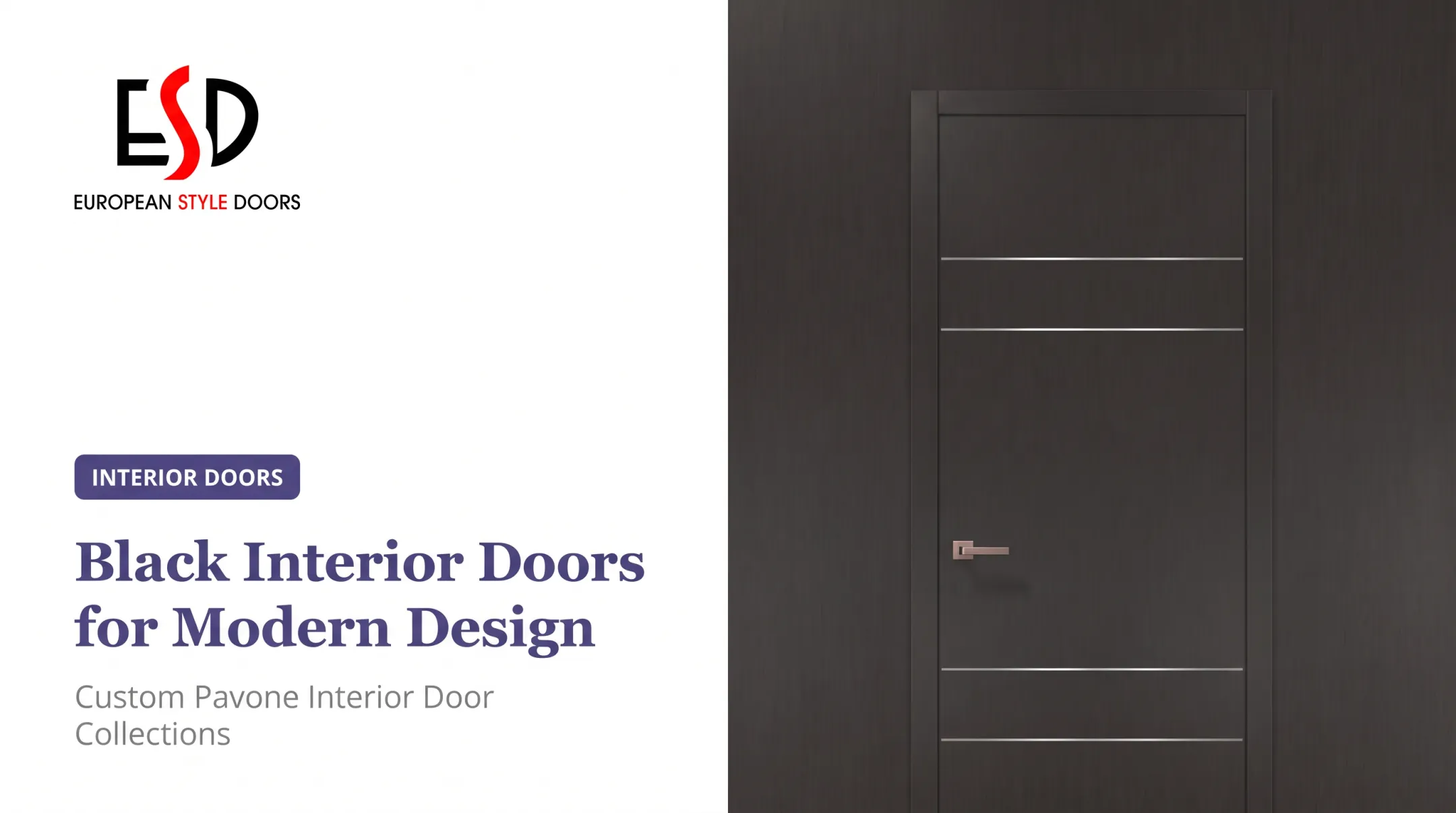
Black interior doors come in painted, laminate, or veneer finishes, and "black" covers more ground than people assume. True black is different from charcoal, graphite, or deep brown-blacks like wenge. ESD's Okasha-Black laminate, for instance, is a deep black with subtle irregular horizontal grain, while Wenge-76 veneer leans toward a near-black brown with a warmer undertone.
Black introduces visual weight. It frames a doorway, gives it presence, and can echo black window frames, lighting fixtures, cabinetry, or hardware elsewhere in the home.
Practical benefits:
- Creates strong contrast against light walls, turning a plain door into a design element
- Adds definition and structure to large, open-plan rooms or neutral corridors
- Fits modern, European-inspired, industrial, and transitional interiors
- May make light dust less visible, though fingerprints and uneven sheen can still show
A Houzz feature on black interior doors makes a similar point: black doesn't repel dirt, and fingerprints don't disappear just because the surface is dark, according to Houzz's design feature.
Where Black Works Best
Home offices, libraries, formal dining rooms, bedrooms, and select hallways all suit a black door when the goal is a grounded, sophisticated mood. Black generally needs more light to balance it, whether that's abundant natural light during the day or well-placed fixtures at night.
Hardware matters here. Matte black, brass, and bronze all pair well with black doors, but choose based on your walls, floors, and nearby finishes rather than defaulting to one option. ESD's GL31 door, with its dark striped wood veneer and chrome hardware, shows how metal finish changes the whole effect of a dark panel.
High-Traffic Considerations
In busy areas, specify a finish built for repeated cleaning. ESD finishes its doors with two-component polyurethane paint from ICA in Italy, producing a film with high mechanical and chemical resistance, which matters more in a mudroom or kids' hallway than color choice ever will.
Black vs White Interior Doors: What Is Better?
Neither color wins outright. The better choice supports your room's light, scale, architectural style, and how doors relate to the spaces next to them.
Choose white when:
- The room is small, dim, or visually busy and you want a quieter look
- Your trim and walls are already light and you want doors to recede
- Décor changes often, or you need one finish that works across many rooms
Choose black when:
- The room gets enough light to support a bolder, contemporary statement
- You already have dark window frames, cabinetry, or hardware to echo
- A large or open layout needs visual anchors so doors don't disappear
Mixing both can work too. A common approach: black doors in common areas like the living room and office, white doors in private spaces like bedrooms and bathrooms. Keep trim and hardware consistent across both so the contrast feels planned, not accidental.

Before You Order, Check These
- Wall and trim undertones in natural and artificial light
- Flooring tone and finish
- Light at different times of day, not just one walkthrough
- Sightlines when doors are open
- Room function and daily traffic
- Cleaning habits and finish sheen
- Custom sizing needs
- Hardware finish and style
- Installation requirements, including frame and casing fit
Always test a physical sample or finish board in the actual opening. Colors shift under morning light, afternoon light, and lamplight, sometimes more than people expect.
Real-World Design Examples and Project Considerations
Scenario one: a dark, narrow hallway. A homeowner with a dim, boxed-in hallway swaps a heavy wood door for a white-finish option, like ESD's White-Ash laminate on a California-collection door. Paired with light walls and matching trim, the hallway reads larger and less closed-in, with flooring doing the visual work instead of the door.
Scenario two: an open-plan living space. A designer working with a large, light-filled room needs the door openings to feel intentional rather than lost in the wall. A black door from ESD's Modern collection, with its tall curved frosted-glass insert, becomes the architectural anchor the space was missing. These are illustrative design scenarios based on ESD's product lineup, not reported customer outcomes.
Before you order, a short checklist keeps sizing, finish, and install timing aligned with the rest of the project.
Ordering Checklist
- Confirm exact opening measurements
- Decide door configuration and handing (left or right swing)
- Check frame and casing requirements against your wall thickness
- Order a finish sample before committing to the full run
- Select hardware finish and style
- Confirm delivery timing against your project schedule
- Decide whether professional installation is needed
If you're comparing custom black and white interior door finishes, European Style Doors can walk you through available colors, finishes, custom sizing, and complete installation-ready kits. Nationwide delivery is available, with installation support across California, Nevada, Arizona, and Florida.
Conclusion
White is generally the more flexible, visually quiet choice. Black is usually the stronger pick when you want contrast, definition, and a deliberate design statement. Neither is universally better; the right one depends on your room.
Judge the color in the actual space, alongside the finish, material, hardware, trim, and lighting you're working with. A swatch on a screen rarely tells the full story.
Before ordering for one room or an entire home, compare physical samples side by side, and confirm measurements and installation details so the door you pick is also the door that fits.
Frequently Asked Questions
Which white color is best for doors?
It depends on your room's natural light, wall and trim undertones, and flooring tone. Cool whites suit north-facing rooms, while warmer whites work better in south-facing light. Test a physical sample in the room before deciding.
What is the most popular color for interior doors?
White remains a widely used neutral for trim and doors, while black and other dark finishes have grown popular for contemporary contrast. Popularity shouldn't replace checking what actually suits your home's lighting and layout.
What is the best paint to use on interior doors?
Use a durable interior trim or door enamel suited to your door material, typically in a semi-gloss or satin sheen for easier cleaning. Follow the manufacturer's prep and curing instructions, since some finishes need up to 30 days to fully harden.