
The right door helps. But "the right door" isn't just a slab rating on a spec sheet. It's the slab, the frame, the hinges, the perimeter seals, and the gap at the bottom, all working as one system. Skip any piece and sound finds a way through.
This guide compares solid-core, solid-wood, acoustic-rated, custom, and retrofit interior doors so you can match the option to your room. One note before we start: no interior door is truly "soundproof." The goal is meaningful reduction, not silence.
Key Takeaways
- Solid-core and solid-wood doors block more airborne sound than hollow-core slabs because of added mass and density
- Perimeter seals, the bottom gap, and frame fit matter as much as the door itself
- Documented STC or lab-test data beats a product description every time
- Bedrooms, offices, and media rooms each call for a different performance target
- Custom sizing and professional installation close the gaps a stock door often leaves behind
Overview of Sound-Reducing Interior Doors in the U.S. Market
A sound-reducing interior door is one selected or built to limit how much airborne sound passes between rooms. That's different from sound absorption, which controls echo and reverberation inside a single room using soft materials like rugs or acoustic panels.
A door reduces transmission; it doesn't fix a room that already sounds harsh.
Demand for these doors has grown alongside remote work, home offices, nurseries, and media rooms. Homeowners want conversations, calls, and TV audio to stay where they belong. Designers and builders face the same request on nearly every bedroom and office opening now.
How STC Fits In
Sound Transmission Class, or STC, is the standard U.S. rating for comparing airborne sound transmission loss. It's calculated using lab measurements.
The ASTM E413 standard notes that STC ratings correlate generally with how audible speech, TV, and music sound through a partition. Higher numbers mean less sound gets through.
A few things to keep in mind:
- STC ratings come from laboratory testing, not from guessing based on door weight
- A rating for a bare slab is not the same as a rating for the installed assembly
- The door should be evaluated with its frame, hinges, latch, perimeter gasket, bottom seal, and threshold included

With that framework in place, here's how the main door types compare.
Best Sound-Reducing Interior Doors
Five factors matter most when comparing options: core density and mass, documented acoustic testing, seal compatibility, design flexibility, and how demanding the installation is. Here's a side-by-side look before we break down each type.
| Option | Core/Construction | Acoustic Documentation | Best For | Installation Note |
|---|---|---|---|---|
| ESD custom doors | Veneer, laminate, honeycomb-filled panels | Not independently STC-rated; verify per model | Custom-styled bedrooms, offices, whole-house remodels | Delivered as a complete kit with frame, seals, hinges |
| Solid-core wood/composite | MDF, engineered wood, composite | Varies by manufacturer; confirm specs | Bedrooms, home offices, nurseries, bathrooms | Needs heavy-duty hinges and tight frame fit |
| Solid-wood | Natural wood species, panel or slab | Varies with thickness and joinery | Libraries, offices, premium bedrooms | Heavier; may need reinforced hinges |
| Tested acoustic/studio-grade | Dense slab plus engineered seal system | Lab-tested STC, often 31-47+ | Home theaters, music rooms, podcasting spaces | Demanding frame and hardware requirements |
| Retrofit solid-core replacement | Existing frame, new heavier slab | Depends on added seals | Budget-conscious bedroom/office upgrades | Requires jamb and hinge inspection first |
European Style Doors Custom Interior Doors
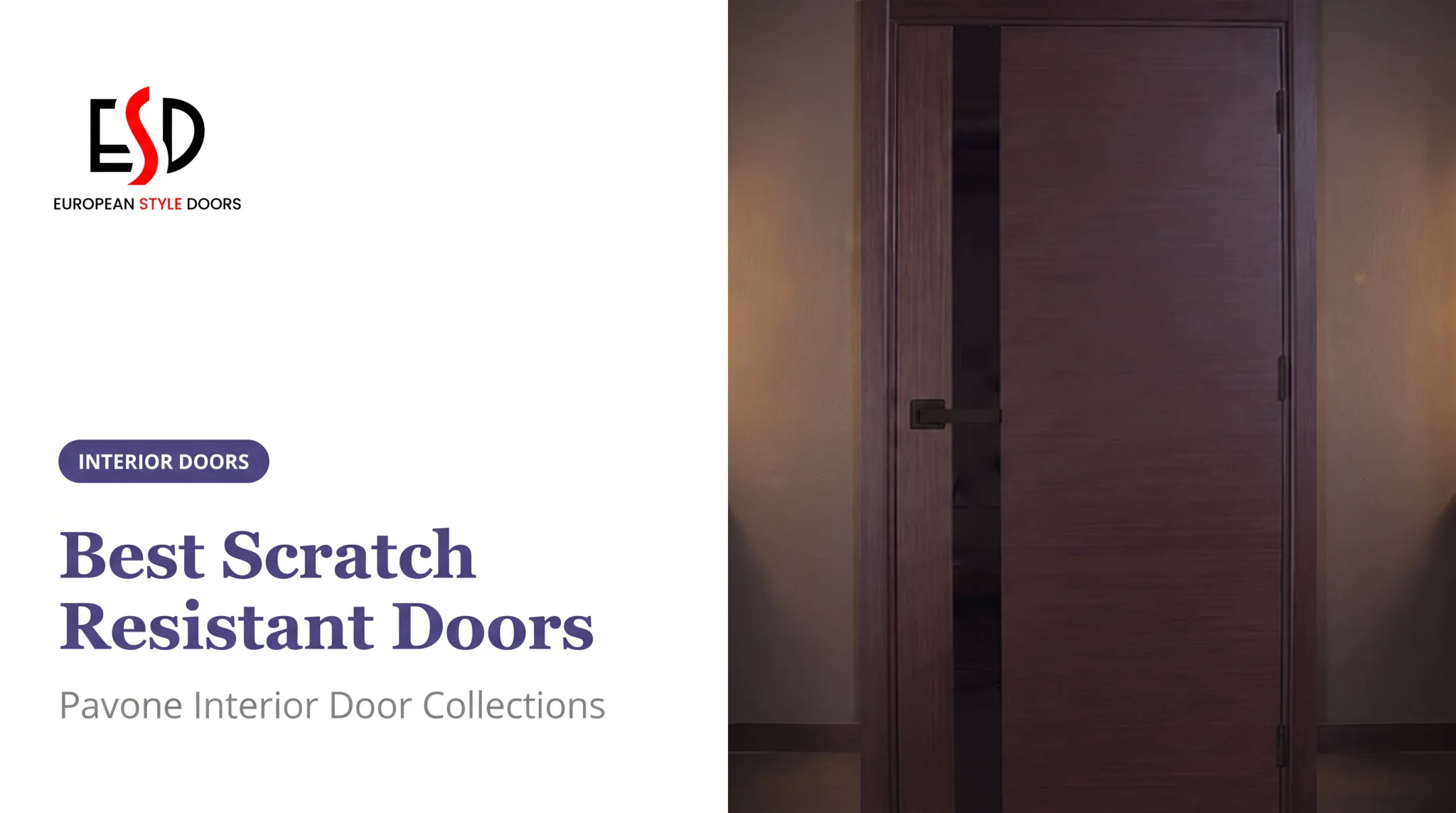
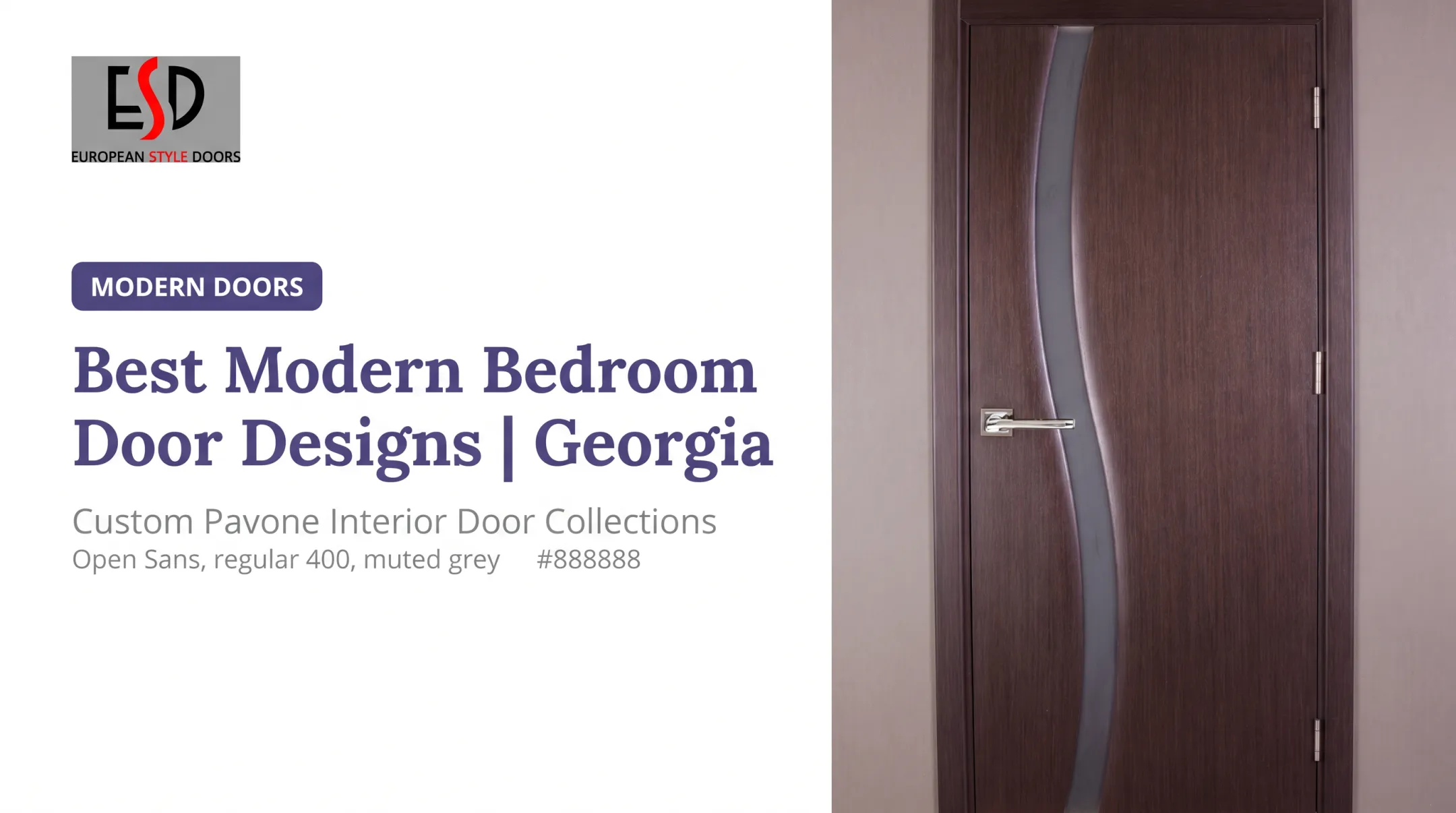
European Style Doors (ESD) is the exclusive U.S. distributor of Pavone Designs Inc. interior doors, offering classic and contemporary collections in wood veneer, German laminate, and Indian laminate. Doors ship as complete kits, meaning frame, moldings, hinges, handles, and seals arrive together, finished and ready to install without priming or painting.
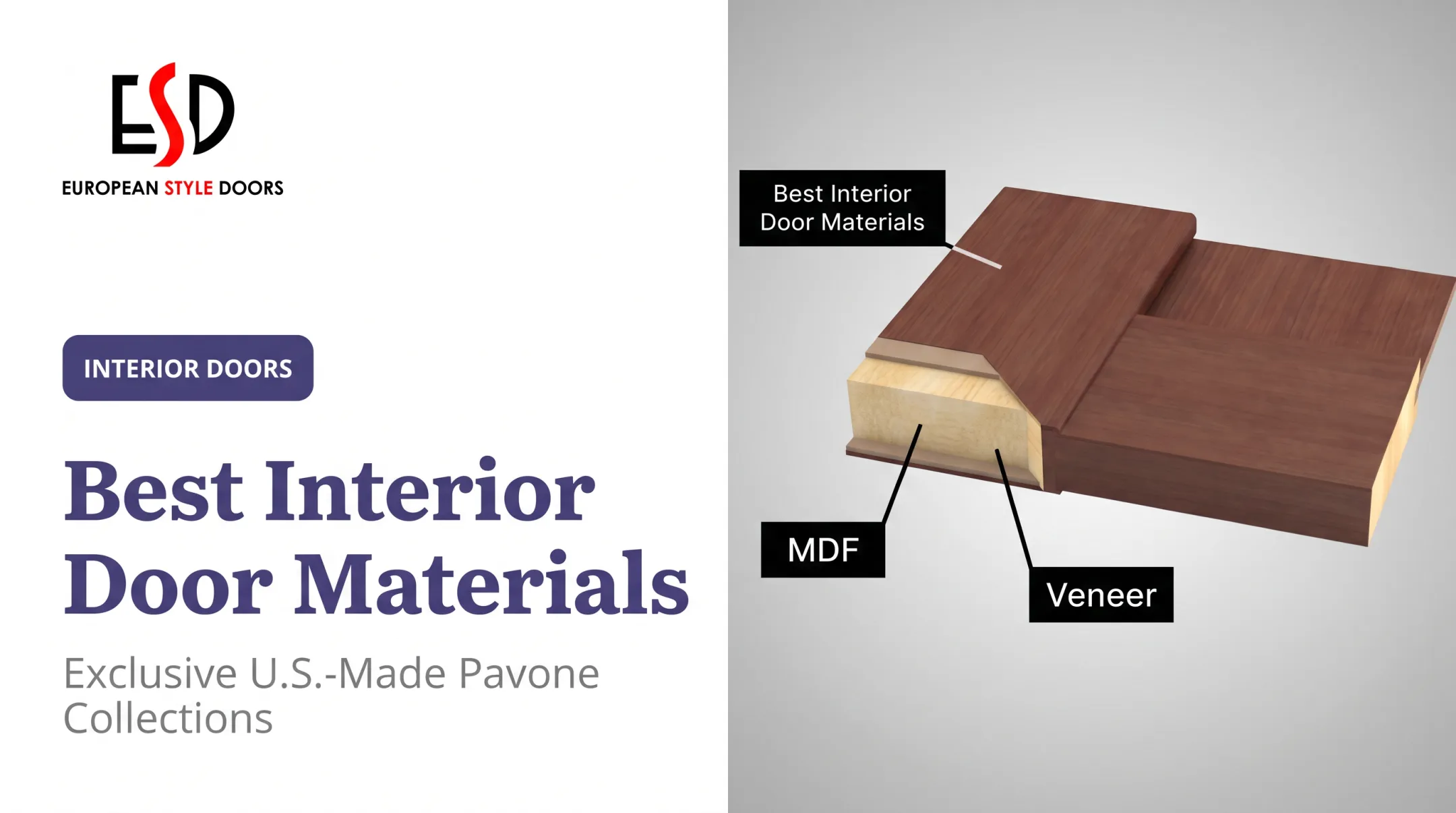
Several collections, including the Elegance and Modern lines, use overpasted pine blocks, honeycomb filler, and a 3mm MDF layer with noise-preventive sealant built into the door frame. That construction adds mass and closes the frame-to-slab gap, which matters more than most buyers realize.
ESD doesn't publish an independent STC rating on these collections. If your project needs a documented number for a theater or music room, ask for the specific product's test data before ordering.
For most bedrooms, offices, and whole-home remodels where custom sizing and finish selection matter alongside noise control, this is where the balance usually lands.
Request specs and installation details for your room type rather than choosing by photo alone. A door that looks heavy isn't always the one tested to perform.
Solid-Core Wood or Composite Interior Doors
For ordinary household noise, solid-core construction is the practical starting point. Compared with a hollow-core slab, which is often just a thin veneer wrapped around a cardboard honeycomb, a solid-core door adds real mass.
Common core materials include:
- Engineered wood and MDF cores, dense and consistent
- Composite cores blending wood fiber with binding agents
- Particleboard or wood-based cores, varying by manufacturer
Not all solid-core doors perform identically. Manufacturer specifications vary, so verify thickness and density claims rather than assuming "solid-core" guarantees a specific result.
A heavier slab also needs support. Heavy-duty hinges, a compatible frame, continuous perimeter gasketing, and a properly fitted door bottom keep the extra mass from being undermined by gaps around the edges. Skip the seals, and a 100-pound door can still leak sound like a lightweight one.
This option suits bedrooms, home offices, nurseries, bathrooms, and shared living spaces well. It's generally not enough on its own for a recording studio or high-isolation home theater without additional sealing upgrades.
Solid-Wood Interior Doors
Solid wood reduces sound through sheer mass, but performance swings depending on species, thickness, panel construction, and how tightly the joints fit together. A dense hardwood slab behaves differently than a softwood door with decorative routing.
Weight varies meaningfully by species. At a common 1-3/4 inch thickness, published architectural-door weight data shows oak averaging roughly 7 pounds per square foot, birch around 5.5, and white pine closer to 3.5, compared with about 4.5 for a standard solid-core door.

Heavier generally helps, but weight alone isn't an acoustic guarantee.
Compared with engineered solid-core doors, solid wood typically costs more, requires more maintenance (expansion, finishing, occasional warping), and offers a premium natural look that laminate can't fully replicate.
A word of caution: decorative panels, deep routed details, and thin raised sections can weaken a solid-wood door's performance compared with a uniform, dense slab. If sound reduction matters as much as appearance, ask for the full tested assembly data, not just the wood species.
Good fits: bedrooms, home offices, libraries, and living areas where a premium natural material matters alongside privacy.
Tested Acoustic or Studio-Grade Interior Doors
This category is built differently from the start. Acoustic-rated doors are engineered and tested as a complete assembly, combining a dense slab with specialized gaskets, an automatic door bottom, and a frame designed to match.
Manufacturer test data shows how specific this engineering gets. Haley Brothers' spec sheet lists an acoustic rating of STC 31-47 for its sound-core door, built on a 1-3/4 inch slab paired with specific perimeter gaskets, corner pads, and an automatic door bottom. Those parts are specified components, not optional add-ons.
A separately tested wood door from Riverbank Acoustical Laboratories reached STC 46 using a metal frame, bubble seals at the head and jambs, heavy-weight hinges, and a full-mortise automatic bottom.
These doors make sense when the goal is containing music, podcasting audio, home-theater sound, or sensitive conversations, not just muffling everyday household noise. The trade-offs are real:
- Significantly heavier, which stresses hinges and framing
- Higher cost than standard solid-core or solid-wood options
- More demanding installation and hardware requirements
- Reduced design flexibility in some collections
- Glazing and lite kits must stay within the manufacturer's tested configuration
Coordinate with your supplier on walls, ceilings, floors, and ventilation paths too. A great door surrounded by a weak wall assembly won't deliver the rating on the spec sheet.
Retrofit Solid-Core Replacement With Upgraded Seals
Replacing a hollow-core slab with a properly sized solid-core door can be a smart, lower-disruption upgrade, provided the existing frame is sound and can support the added weight.
Before ordering a replacement, check:
- Jamb condition - look for warping, rot, or loose fasteners
- Hinge capacity - lightweight hinges won't hold a heavier slab long-term
- Latch alignment - a new slab may shift strike-plate positioning
- Under-door clearance - flooring changes can affect the gap
- Surrounding wall condition - cracks or gaps undermine any door upgrade
A heavier replacement slab still needs perimeter seals and a bottom seal. Skip those, and you've added weight without closing the air paths that actually carry sound.
Compared with installing a full pre-hung acoustic assembly, a retrofit is typically less disruptive and less expensive, but expect a smaller performance jump. For high-isolation needs, a complete assembly swap verified against lab data usually outperforms a retrofit.
How We Chose the Best Sound-Reducing Interior Doors
Our evaluation prioritizes verified acoustic performance and installation quality over marketing language or brand familiarity. Door weight alone tells you less than you'd think.
We looked at:
- Documentation: manufacturer data, independent lab testing, applicable STC standards, and whether a rating applies to the bare slab or the full installed assembly
- Construction: solid versus hollow core, mass, thickness, internal damping, panel design, glazing, frame type, and seal compatibility
- Room match: ordinary speech and TV noise, work-call privacy, sleeping areas, children's rooms, home theaters, music rooms, and multi-unit openings
Common Selection Mistakes
Buyers get this wrong in predictable ways:
- Choosing a door by appearance alone and skipping the spec sheet
- Ignoring the gap under the door, often the single biggest leak point
- Assuming a high-STC slab fixes a fundamentally weak surrounding wall
- Adding a heavier slab without checking hinge capacity first
- Picking pocket, barn, louvered, or glazed doors without understanding their acoustic limits
A gap or leak can significantly degrade sound isolation, and the AISC's sound-isolation guide notes that acoustically sensitive openings typically need full-perimeter gaskets, not partial coverage.
Buyer Checklist
- Identify the sound path (what's actually traveling, and from where)
- Measure the opening precisely before shopping
- Set a target performance level for the room's purpose
- Verify tested specifications, not just marketing copy
- Confirm hardware, hinges, and seal compatibility
- Plan professional installation for heavier or tested assemblies
Conclusion
The best sound-reducing interior door is almost always a dense, well-fitted slab paired with a complete sealing system, frame, hinges, gaskets, and bottom seal all working together. Beyond that, the right choice depends on your room, your noise source, and your design priorities.
Compare documented assembly performance, not the word "soundproof" on a listing page. Ask for core construction details, seal specs, and frame compatibility before you buy.
If you're weighing custom sizing, finish options, or installation-ready interior doors for a remodel, European Style Doors works directly with homeowners, designers, builders, and contractors nationwide to spec doors for the room, not just the opening.
Frequently Asked Questions
What type of interior doors are best for soundproofing?
Solid-core or solid-wood doors with continuous perimeter seals and a well-fitted bottom generally outperform hollow-core doors. For high-isolation needs like home theaters, choose a tested acoustic assembly instead of a standard slab.
Are solid-core doors better than hollow-core doors for reducing sound?
Yes, generally. Solid-core doors add real mass where hollow-core slabs are mostly air inside a thin shell. That said, a poorly sealed solid-core door can still underperform a well-sealed one.
What STC rating should an interior door have?
It depends on the room. Bedrooms and offices typically target moderate reduction, while home theaters and music rooms often look for lab-tested assemblies in the STC 40s or higher. Always check the tested source, not a general rule of thumb.
Do door seals really improve sound reduction?
Yes. Perimeter gaskets, door bottoms, and thresholds close the air paths around the slab. A heavy door with gaps at the edges can still let sound pass almost as freely as a lightweight one.
Are glass-panel interior doors good for sound reduction?
Glazing usually creates a weaker acoustic path than a solid slab. Laminated or acoustic-rated glass in a smaller panel can help, but confirm the complete assembly's tested performance before assuming any glass door blocks sound well.
Can I make an existing interior door quieter without replacing it?
Often, yes. Start by checking for gaps, adding perimeter seals and a door sweep, and adjusting the frame fit. Only add mass (a heavier slab) after confirming hinges and surrounding sound paths can handle it.